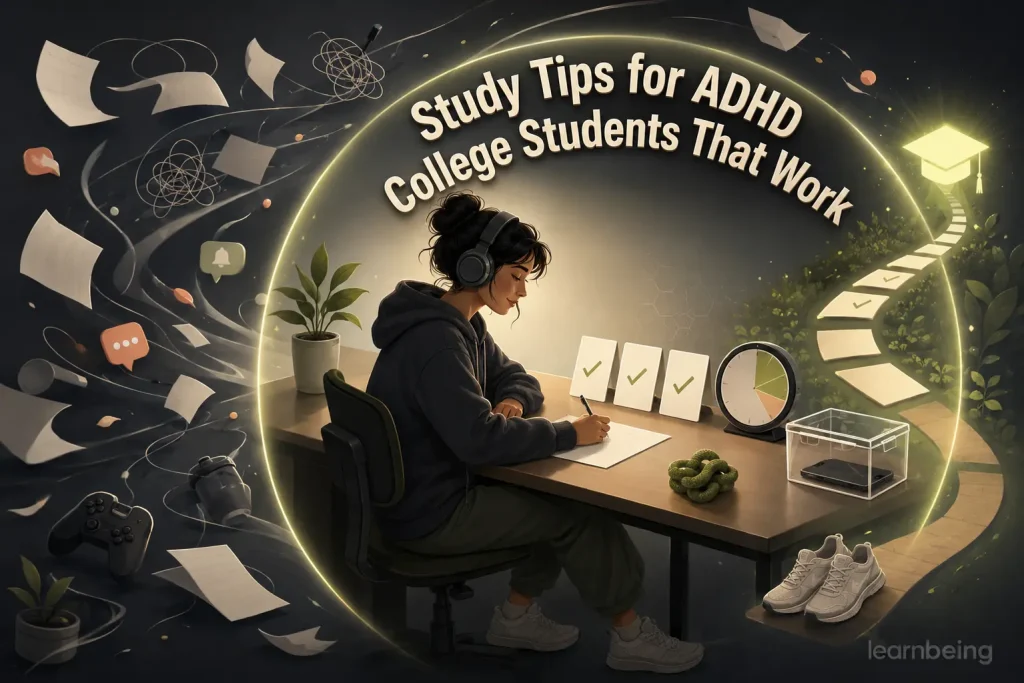
College can feel unusually demanding for students with attention-deficit/hyperactivity disorder. Lectures move quickly, assignments overlap, deadlines are spread across different platforms, and much of the work must be completed without anyone checking whether you started.
The problem is not usually a lack of intelligence or ambition. ADHD can affect task initiation, working memory, time awareness, sustained attention, organization, and emotional regulation. A student may understand the material but still struggle to begin an assignment, remember a deadline, or remain focused long enough to finish.
Effective study tips for ADHD college students are therefore less about forcing longer hours and more about creating structure outside the brain. Short work periods, visible reminders, active learning, reduced distractions, and realistic routines can make studying easier to start and repeat.
Why Studying in College Can Be Difficult With ADHD
College removes much of the structure students may have relied on in high school. Professors provide deadlines, but they do not normally monitor daily progress. A paper assigned six weeks in advance may feel unimportant until the final evening.
Common challenges include:
- Underestimating how long assignments will take
- Forgetting deadlines that are not immediately visible
- Becoming distracted during reading or lectures
- Struggling to begin large or unclear tasks
- Losing notes, files, or course materials
- Hyperfocusing on one subject while neglecting others
- Depending on last-minute urgency for motivation
- Feeling overwhelmed by multi-step projects
- Having difficulty returning to work after a break
- Studying for hours without actively learning the material
Not every student experiences ADHD in the same way. One person may struggle primarily with attention, while another may have more difficulty with impulsivity, restlessness, organization, or emotional overload. The most useful study routine is one that addresses the student’s specific barriers.
Build One Reliable Planning System
Using several planners, apps, notebooks, and reminder systems often creates more confusion. Choose one primary place to record every academic responsibility.
This could be:
- A paper planner
- A digital calendar
- A task-management application
- A spreadsheet
- A calendar combined with a short daily task list
Enter important dates from every syllabus at the beginning of the semester, including:
- Assignment deadlines
- Examinations
- Quizzes
- Presentations
- Laboratory sessions
- Registration deadlines
- Group meetings
- Project milestones
Checking the system at the same time each day is more important than selecting the perfect application. A useful planning system should be easy to open, quick to update, and visible enough that it is not forgotten.
Use a Weekly and Daily View
A semester calendar shows what is coming, but it may not explain what to do today. Use three planning levels:
- A semester calendar for major deadlines
- A weekly plan for classes and study blocks
- A daily list containing a few clear actions
The daily list should remain short. A list of 25 tasks can create paralysis rather than motivation. Identify the three most important academic actions and treat everything else as secondary.
Turn Large Assignments Into Physical Actions

“Write research paper” is not a single task. It is a project containing several decisions and actions. Large tasks often feel difficult to start because the first step is unclear.
Break the assignment into specific actions such as:
- Open the assignment instructions.
- Highlight the requirements.
- Select three possible topics.
- Choose one topic.
- Find five useful sources.
- Create a working thesis.
- Draft the outline.
- Write the introduction.
- Complete the first section.
- Edit the full draft.
- Check the citation format.
- Submit the final document.
Each step should begin with a visible verb. “Open,” “find,” “write,” “review,” and “submit” are easier to act on than broad labels such as “biology” or “essay.”
Make the First Step Extremely Small
When task initiation is the main barrier, reduce the first action until it feels almost too easy.
Instead of telling yourself to study for two hours, begin with:
- Open the textbook.
- Read one page.
- Answer one practice question.
- Work for five minutes.
- Write one sentence.
- Create the document and add the title.
Starting does not guarantee a long study session, but it reduces the mental barrier between thinking about the task and actually doing it.
Study in Short, Adjustable Focus Sessions
Long, unbroken study sessions can be difficult when attention fluctuates. Short work periods create a visible ending and make the task feel less intimidating.
A common starting structure is:
- Work for 20 to 25 minutes.
- Take a 5-minute break.
- Repeat the cycle three or four times.
- Take a longer break afterward.
This is often called the Pomodoro Technique, but the traditional timing is not mandatory. Some students work better with:
- 10 minutes of work and 3 minutes of rest
- 30 minutes of work and 10 minutes of rest
- 45 minutes of work and 15 minutes of rest
- One clearly defined task instead of a timed session
Choose a period that is challenging enough to make progress but short enough to repeat.
Give Every Session a Clear Target
A timer alone will not prevent unproductive studying. Define what should be completed before beginning.
A weak target is:
“Study psychology.”
A clearer target is:
“Create ten questions from Chapter 4 and answer them without looking at my notes.”
A specific target makes it easier to recognize progress and decide what to do next.
Use Active Recall Instead of Only Rereading
Rereading notes can create familiarity without confirming that the information can be remembered during an exam. Active recall requires retrieving the answer from memory.
Ways to practise active recall include:
- Closing the textbook and summarizing a section
- Turning headings into questions
- Creating flashcards
- Completing practice problems without notes
- Explaining the topic aloud
- Writing everything remembered on a blank page
- Teaching the concept to another person
- Taking a practice quiz under timed conditions
After attempting an answer, check it against the course material. The effort involved in retrieving information helps reveal what is understood and what needs more attention.
Review Material With Spaced Practice
Cramming can create short-term familiarity, but much of the material may disappear soon after the examination. Spaced practice distributes study sessions across several days or weeks.
A simple review schedule might be:
- First review: the same day as the lecture
- Second review: two or three days later
- Third review: one week later
- Fourth review: before the examination
Each session can be relatively short. The goal is to return to the information repeatedly instead of trying to relearn an entire unit in one evening.
Combining spaced practice with active recall is generally more useful than repeatedly reading or highlighting the same pages.
Make the Study Environment Easier to Control
A student should not have to rely entirely on willpower while studying next to several sources of distraction.
Possible study locations include:
- A quiet library floor
- A reserved study room
- An empty classroom
- A low-traffic corner of a campus building
- A structured tutoring center
- A desk used only for academic work
The ideal environment differs between students. Complete silence helps some people, while others focus better with predictable background sound.
Reduce Digital Distractions
Before beginning a session:
- Put the phone on Do Not Disturb.
- Place it outside immediate reach.
- Close unrelated browser tabs.
- Log out of social media.
- Use full-screen mode.
- Block distracting websites temporarily.
- Download required materials before disconnecting from the internet.
- Keep only the applications needed for the current task open.
Removing a distraction before studying is easier than repeatedly resisting it during the session.
Add Helpful Stimulation Carefully
Some students concentrate better when they have a controlled amount of stimulation. Depending on the person and task, this may include:
- Instrumental music
- White or brown noise
- A standing desk
- A quiet fidget object
- Chewing gum
- Walking while reviewing flashcards
- Changing locations between study blocks
If music leads to singing, browsing, or frequently changing songs, it has become a distraction. The test is whether the strategy improves task completion, not whether it feels pleasant.
Try Body Doubling
Body doubling means working while another person is present and completing their own task. The other person does not need to tutor or supervise. Their presence can provide structure and accountability.
Body doubling can happen:
- In a library with a friend
- During a silent video call
- In a study group
- At a tutoring center
- In a shared campus workspace
- Through an academic coaching session
At the beginning, each person can state what they intend to finish. At the end, they briefly report their progress. This creates a clear start and finish without turning the session into a social event.
Match Tasks to Attention and Energy
Concentration is not equally strong at every hour. Notice when it is naturally easier to begin demanding work.
Use higher-focus periods for:
- Complex reading
- Writing
- Mathematics
- Practice examinations
- Difficult problem-solving
Use lower-energy periods for:
- Organizing files
- Formatting documents
- Reviewing flashcards
- Watching recorded lectures
- Checking citations
- Preparing materials for the next day
If prescribed ADHD medication is part of a treatment plan, follow the prescriber’s instructions. Students may notice that certain hours are more productive, but medication timing or dosage should not be changed without professional guidance.
Create Artificial Deadlines
A distant deadline may not create enough urgency to begin. Set an earlier personal deadline and create intermediate checkpoints.
For a paper due Friday, the schedule might be:
| Day | Checkpoint |
|---|---|
| Monday | Confirm topic and collect sources |
| Tuesday | Finish outline |
| Wednesday | Complete first draft |
| Thursday | Edit, proofread, and format |
| Friday | Final check and submission |
Treat the earlier dates as real commitments. Sharing the schedule with a classmate, tutor, or academic coach can add accountability.
Always leave a buffer before the official deadline. Technology problems, fatigue, unexpected responsibilities, and underestimated tasks become more manageable when the work is not scheduled for the final hour.
Choose ADHD-Friendly Study Methods
Some common study habits feel productive but require too much passive attention. Replacing them with active, structured methods can improve engagement.
| Common study approach | Why it may be difficult | ADHD-friendly alternative |
|---|---|---|
| Rereading an entire chapter | Passive and easy to lose focus | Turn headings into questions and answer them |
| Studying for several hours continuously | No immediate finish point | Use short timed study blocks |
| Keeping deadlines mentally | Working memory can be unreliable | Record everything in one visible calendar |
| Writing “study” on a task list | The action is unclear | Name the exact chapter, questions, or problems |
| Waiting to feel motivated | Motivation may arrive too late | Start with a five-minute action |
| Studying beside a phone | Notifications interrupt attention | Use Do Not Disturb and place it out of reach |
| Cramming the night before | Creates overload and sleep loss | Review material in several short sessions |
| Highlighting most of the page | Does not test understanding | Use active recall and self-quizzing |
| Planning every minute perfectly | One delay can ruin the plan | Use flexible time blocks with buffer periods |
| Studying completely alone | Can reduce accountability | Try body doubling or a structured study group |
Take Notes That Require Participation
Copying every word from a lecture can consume attention without improving understanding. Instead, organize notes around ideas, questions, examples, and connections.
An effective note page might contain:
- Main concept
- Supporting explanation
- Example
- Question or confusion
- Connection to earlier material
- Possible exam question
- Short summary in your own words
After class, spend five to ten minutes cleaning up the notes. Add missing information while the lecture is still fresh and convert key points into questions for later review.
Use Recorded Lectures Strategically
If recordings are available, avoid repeatedly watching the entire lecture. Go directly to the unclear section, pause to take notes, and then test whether you can explain the idea without replaying it.
Watching a lecture is exposure to the material. Answering questions, solving problems, and explaining concepts demonstrate whether learning has occurred.
Improve Reading With a Clear Purpose
Before reading a chapter, decide what information you are expected to learn.
Use this process:
- Preview the headings, diagrams, summaries, and review questions.
- Convert headings into questions.
- Read one small section.
- Stop and summarize it without looking.
- Write down anything that remains unclear.
- Continue to the next section.
- Review the questions at the end.
A reading guide or set of questions gives the brain something specific to search for. It also prevents reaching the end of several pages without remembering what was read.
Prepare for Exams Before Exam Week

Exam preparation begins during the first week of a course, not when the examination appears on the calendar.
Build a Review Set as You Learn
After each lecture or chapter:
- Create a few flashcards.
- Write possible exam questions.
- Save difficult practice problems.
- Summarize the main idea.
- Mark areas that need clarification.
- Review mistakes from quizzes.
By exam week, the study materials are already prepared.
Recreate the Testing Conditions
If possible, complete a practice test without notes, notifications, or frequent breaks. Use a timer when the actual examination will be timed.
Afterward, divide mistakes into categories:
- Did not know the material
- Misread the question
- Forgot a step
- Ran out of time
- Made a careless error
- Changed a correct answer
- Became distracted
Different mistakes need different solutions. Learning more content will not solve a time-management problem, just as extra time may not solve missing knowledge.
Use Rewards to Support Task Completion
Large academic rewards are often too distant to feel motivating. Add small, immediate rewards after defined work periods.
Examples include:
- A favorite snack after completing a practice set
- One episode after finishing the planned study blocks
- A short walk after reading a section
- Time with friends after submitting an assignment
- A coffee break after completing a draft
The reward should follow the action rather than interrupt it. It should also have a clear ending. A five-minute break that becomes two hours of scrolling will make returning to work more difficult.
Build a Realistic ADHD Study Routine
A study routine should be repeatable during ordinary weeks, not designed only for periods of unusually high motivation.
A sample routine might look like this:
| Time | Activity |
|---|---|
| After class | Review notes for five minutes |
| Early afternoon | Complete one difficult 25-minute study block |
| Short break | Move, drink water, or eat a snack |
| Second block | Practise questions or problems |
| Late afternoon | Attend tutoring or study with a classmate |
| Evening | Complete lower-focus administrative tasks |
| Before bed | Check tomorrow’s schedule and prepare materials |
The exact schedule is less important than having predictable cues. Studying after a particular class, meal, or campus activity can reduce the number of decisions needed to begin.
Recover Quickly After Procrastination
Procrastination often creates shame, and shame can make a delayed task even harder to approach. Instead of spending more time judging the delay, restart with the smallest useful action.
Use this reset:
- Identify the actual deadline.
- List what remains unfinished.
- Remove nonessential steps.
- Choose the smallest next action.
- Work for ten focused minutes.
- Ask for help early if the deadline is no longer realistic.
One missed study session does not destroy the entire plan. Avoid waiting for the next week, month, or semester to restart.
Ask About Academic Accommodations
Eligible students with ADHD may be able to receive academic adjustments through their college’s disability services office.
Depending on documented needs and institutional policies, possible accommodations may include:
- Extended examination time
- A reduced-distraction testing location
- Permission to record lectures
- Note-taking support
- Assistive technology
- Early registration
- Accessible course materials
- Breaks during longer examinations
An ADHD diagnosis does not automatically provide every accommodation. The college usually reviews documentation and determines appropriate adjustments based on how the condition affects the student academically.
Unlike high school, the student normally has to contact disability services, provide the required documentation, and request support. Starting this process early is important because accommodations may not be applied retroactively.
Use Available Campus Support
Disability accommodations are only one form of support. College students can also use:
- Academic advising
- Tutoring centers
- Writing centers
- Counseling services
- Professor office hours
- Peer mentoring
- Study-skills workshops
- ADHD coaching
- Student success programs
- Mental health services
Asking for assistance before a course reaches crisis level provides more options. Professors and tutors can help more effectively when there is still time to review the material or revise the study plan.
Protect Sleep, Food, and Physical Well-Being
A study strategy becomes harder to maintain when basic needs are neglected.
Helpful habits include:
- Keeping a reasonably consistent sleep schedule
- Eating regular meals
- Drinking enough water
- Including movement or physical activity
- Avoiding excessive caffeine
- Scheduling recovery time
- Taking prescribed medication only as directed
- Avoiding the use or sharing of someone else’s medication
Sacrificing sleep to study may increase the number of hours spent with the material while reducing attention, memory, and decision-making the following day.
When Study Strategies Are Not Enough
Productivity techniques cannot replace appropriate healthcare. A student should consider speaking with a qualified professional when attention problems, anxiety, depression, sleep difficulties, medication concerns, or academic stress are significantly affecting daily life.
Difficulty concentrating does not always mean a person has ADHD. Sleep disorders, anxiety, depression, substance use, learning differences, medical conditions, and high stress can produce similar difficulties. A proper evaluation looks at symptoms, history, functioning, and possible alternative explanations.
Students already receiving ADHD treatment should discuss persistent or worsening problems with their healthcare professional rather than changing medication independently.
Frequently Asked Questions
What is the best study method for a college student with ADHD?
There is no single best method, but many students benefit from combining short focus sessions, active recall, spaced practice, visible planning, reduced distractions, and external accountability.
How long should a student with ADHD study at one time?
Some students begin with 20 to 25 minutes, while others prefer shorter or longer periods. The best duration is one that allows meaningful progress without making it difficult to begin or repeat the session.
Does the Pomodoro Technique work for ADHD?
It can help by creating a clear beginning, ending, and break. However, the standard 25-minute format does not suit everyone. Students can adjust the work and break periods based on the task and their attention pattern.
How can college students with ADHD stop procrastinating?
Break the assignment into small physical actions, schedule an earlier personal deadline, use a short starting timer, remove distractions, and work beside another person for accountability.
Is studying with music helpful for ADHD?
It depends on the individual and the task. Predictable instrumental music or background noise may help some students, while lyrics and frequently changing songs may distract others.
What is body doubling for ADHD?
Body doubling means completing work while another person is present and working on their own task. The shared structure can make it easier to start, remain engaged, and finish a study session.
Can college students receive ADHD accommodations?
Students whose ADHD qualifies as a disability may be eligible for reasonable academic adjustments. They generally must contact the college’s disability services office and provide appropriate documentation.
Are active recall and spaced repetition useful for ADHD?
These techniques can make study sessions more active and structured. Active recall tests what a student can retrieve, while spaced repetition revisits material across several sessions instead of relying on cramming.
How can students with ADHD remember assignments?
Record every assignment in one trusted system, add reminders, break projects into checkpoints, and review the schedule at the same time each day.
Should students with ADHD study alone or in groups?
Either option can work. Independent study may reduce social distractions, while a quiet group or body-doubling session may improve accountability. The best choice depends on the task and the student.
Conclusion
College does not reward intelligence alone. It also demands planning, time awareness, organization, and the ability to begin work without immediate supervision—the exact areas that ADHD can make more complicated.
The answer is not to imitate someone else’s perfect routine or force yourself through endless study hours. A better approach is to make tasks visible, smaller, more active, and easier to begin. One calendar, one short work block, one practice question, and one early request for help may seem minor, but those actions create momentum.
A successful ADHD study system will rarely look flawless. It will be flexible enough to survive a difficult week and simple enough to restart after something goes wrong. That ability to return—not perfect consistency—is often what carries a student through college.

admin
Helping students learn better, prepare smarter, and build real career skills at LearnBeing.
View all posts