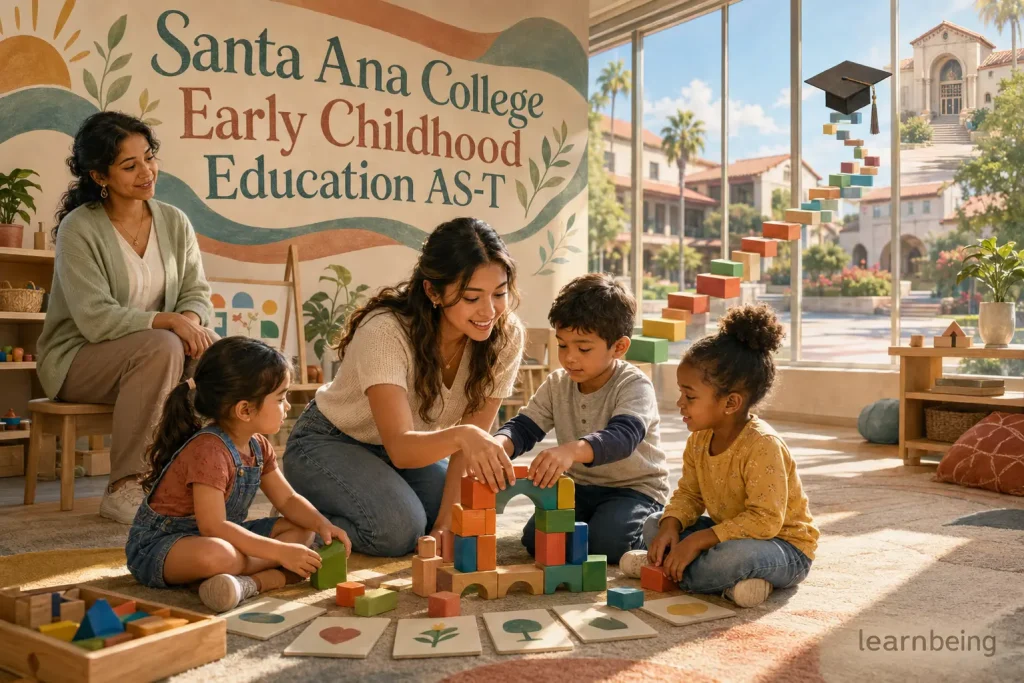
The Santa Ana College Early Childhood Education AS-T is designed for students who want to understand how young children develop, gain practical classroom experience, and transfer to a California State University to continue toward a bachelor’s degree.
Formally known as the Associate in Science in Early Childhood Education for Transfer, the program combines child development theory with curriculum planning, observation, family engagement, health and safety, inclusive teaching, and supervised field experience.
The AS-T can support career goals such as becoming a preschool teacher, infant or toddler educator, after-school teacher, home-based early childhood educator, or paraprofessional. However, some positions may require a California Child Development Permit, additional experience, or further education.
Santa Ana College Early Childhood Education AS-T at a Glance
| Program detail | Information |
|---|---|
| Official award | Associate in Science in Early Childhood Education for Transfer |
| Degree type | AS-T |
| Program code | SAC.ECE.AST |
| Required major coursework | 25 units |
| Total degree requirement | 60 CSU-transferable semester units |
| Minimum transferable GPA | 2.0 |
| Minimum major-course grade | C or P equivalent to C or better |
| General education pathway | Cal-GETC, with certain older patterns potentially accepted in some cases |
| Practical experience | Student teaching field experience |
| Primary transfer destination | California State University system |
| Common bachelor’s fields | Early Childhood Education, Child Development, Human Development, and Child and Adolescent Studies |
What Is the Early Childhood Education AS-T?
An Associate Degree for Transfer is a California community college degree created for students who intend to continue their education within the CSU system.
The Santa Ana College Early Childhood Education AS-T provides foundational knowledge about the physical, cognitive, emotional, social, and creative development of young children. Students learn how children grow, how their environments influence learning, and how educators can plan developmentally appropriate experiences.
This is not simply a collection of childcare courses. The degree follows a structured transfer pathway that combines:
- Early childhood education coursework
- General education classes
- Observation and assessment
- Curriculum development
- Family and community studies
- Diversity and inclusive teaching
- Health, safety, and nutrition
- Supervised student teaching
Students who successfully complete the degree and meet CSU admission requirements can transfer with junior status. Admission is guaranteed to the CSU system, but not necessarily to a particular campus, major, or highly competitive program.
Who Should Consider This Degree?
The Early Childhood Education AS-T may be a strong choice for students who:
- Want to transfer to a CSU for a related bachelor’s degree
- Enjoy working with children from infancy through the preschool years
- Are interested in how children think, communicate, play, and learn
- Want experience planning lessons and classroom environments
- Hope to work in a preschool, childcare center, Head Start program, or community organization
- Intend to pursue higher-level teaching, administration, or child development roles
- Want an academic foundation before applying for a Child Development Permit
The degree is especially suitable for students who see early childhood education as a long-term profession rather than a temporary childcare job. It introduces the responsibilities involved in supporting children while also preparing students for advanced university study.
Santa Ana College AS-T Degree Requirements
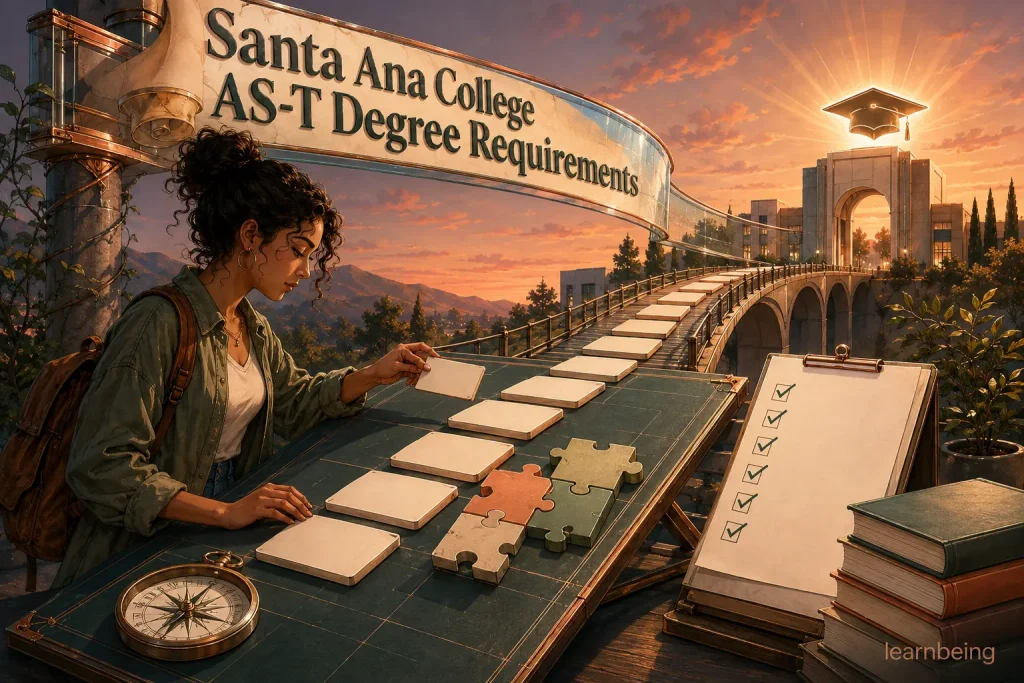
Students must complete both the early childhood education major and the general requirements for an Associate Degree for Transfer.
Complete 60 CSU-Transferable Units
The full degree requires at least 60 semester units that are eligible for transfer to the California State University system.
These units generally include:
- Major coursework
- General education classes
- Transferable electives, when needed
- Courses required for CSU admission or the intended bachelor’s program
Not every course offered by a community college is CSU transferable. Students should build an education plan with a counselor instead of selecting courses without checking how they apply to the degree.
Complete the General Education Pattern
Students normally complete the California General Education Transfer Curriculum, commonly called Cal-GETC.
Depending on a student’s catalog rights and academic history, an older CSU GE Breadth or IGETC pattern may be accepted in certain cases. Because general education rules can change, students should confirm the correct pattern with a Santa Ana College counselor.
Maintain the Required GPA
A minimum GPA of 2.0 is required across CSU-transferable coursework.
Although 2.0 is the stated minimum, it may not be competitive enough for every campus or major. Impacted programs can use higher admission standards. Maintaining the strongest possible GPA can provide more transfer options.
Earn the Required Major-Course Grades
Every course in the major must be completed with:
- A grade of C or better, or
- A Pass grade that is equivalent to C or better
A lower grade may still provide college credit in some situations, but it will not satisfy the major requirement for the AS-T.
Required Early Childhood Education Courses
The Santa Ana College Early Childhood Education AS-T includes 25 units of required core coursework.
| Course | Course title | Units |
|---|---|---|
| CDEV C1000 or APCD 107 | Child Growth and Development | 3 |
| CDEV 110 or APCD 110 | Child, Family, and Community | 3 |
| CDEV 108 or APCD 108 | Observation and Assessment for Early Learning and Development | 3 |
| CDEV 111A | Principles and Practices of Teaching Young Children | 3 |
| CDEV 111B or APCD 111B | Introduction to Curriculum for Young Children | 3 |
| CDEV 112 or APCD 112 | Health, Safety, and Nutrition for Children | 3 |
| CDEV 221 or APCD 221 | Teaching in a Diverse Society | 3 |
| CDEV 296 or APCD 296 | Practicum: Student Teaching Field Experience | 4 |
| Total required core | 25 |
The APCD options are apprenticeship versions of selected child development courses. Students should confirm which version fits their enrollment status and academic plan.
What Students Learn in the Program
The required courses cover different parts of an early childhood educator’s work. Together, they help students connect educational theory with real classroom decisions.
Child Growth and Development
Students explore how children develop physically, socially, emotionally, cognitively, and linguistically. The course introduces major developmental theories while helping future educators recognize age-appropriate behavior and learning patterns.
This foundation is important because effective teaching begins with realistic expectations of what children can understand and do at different stages.
Child, Family, and Community Relationships
Children do not develop separately from their surroundings. Their families, cultures, neighborhoods, schools, and communities all influence their experiences.
This course helps students examine those relationships and learn how educators can build respectful partnerships with families. Communication, cultural responsiveness, and community resources are important parts of this area.
Observation and Assessment
Observation allows educators to understand children without relying only on assumptions. Students learn how to document behavior, recognize developmental patterns, and use their findings to plan suitable learning experiences.
Observation is not about labeling children. It is a professional method for understanding their interests, strengths, needs, and progress.
Principles and Practices of Teaching
This course introduces the responsibilities, ethics, philosophies, and professional practices associated with early childhood education.
Students examine how teachers create supportive environments, guide behavior, encourage development, and make decisions that respect the whole child.
Curriculum for Young Children
Early childhood curriculum involves more than worksheets or predetermined activities. Students learn how to develop play-based, age-appropriate experiences that support multiple areas of growth.
Curriculum may incorporate:
- Language and early literacy
- Art and creative expression
- Music and movement
- Science and discovery
- Early mathematical thinking
- Social-emotional learning
- Dramatic and imaginative play
- Physical development
The goal is to create meaningful experiences that respond to children’s interests and developmental abilities.
Health, Safety, and Nutrition
Young children depend on adults to maintain safe and healthy environments. This course addresses topics such as illness prevention, nutrition, supervision, emergency awareness, classroom safety, and healthy routines.
Students also learn that health and safety practices are connected to children’s readiness to learn.
Teaching in a Diverse Society
Early learning environments include children and families with different languages, cultures, abilities, identities, traditions, and economic circumstances.
This course helps future educators examine bias, inequality, representation, and inclusive teaching. Students learn how classroom materials, communication, and daily practices can help children feel respected and included.
Student Teaching Field Experience
The practicum gives students an opportunity to apply their learning in an early childhood setting.
Under appropriate supervision, students may observe children, participate in routines, support learning activities, develop curriculum, and reflect on their teaching decisions. This experience helps students understand the difference between discussing educational practices and using them with real children.
Skills Developed Through the Degree
Graduates can develop academic, interpersonal, and practical skills that apply across many early childhood education careers.
These skills may include:
- Observing and documenting child behavior
- Planning developmentally appropriate curriculum
- Creating safe and engaging environments
- Supporting children’s emotional and social development
- Communicating with families and colleagues
- Recognizing individual and cultural differences
- Applying child development theories
- Reflecting on teaching practices
- Promoting health and nutrition
- Working as part of an educational team
- Understanding professional and ethical responsibilities
These abilities are useful in classrooms, childcare programs, after-school settings, family support services, and community organizations.
How the CSU Transfer Pathway Works
The Early Childhood Education AS-T is primarily structured for transfer to the California State University system.
After completing the degree and meeting admission requirements, students may apply to bachelor’s programs in areas such as:
- Early Childhood Education
- Child Development
- Human Development
- Child and Adolescent Studies
- Family and Consumer Sciences
- Education-related studies
An AS-T provides guaranteed admission with junior status somewhere within the CSU system for eligible students. It does not guarantee admission to a specific university or a particular academic program.
Students should identify potential transfer campuses early because universities may differ in:
- Required lower-division preparation
- Minimum competitive GPA
- Application deadlines
- Similar-major determinations
- Field experience expectations
- Graduation and credential requirements
Using an official articulation database and working with a transfer counselor can help students avoid taking unnecessary classes.
AS-T vs Other Early Childhood Education Options
Santa Ana College offers different child development pathways. The best option depends on whether a student’s priority is university transfer, classroom preparation, a permit, or faster workforce entry.
| Feature | Early Childhood Education AS-T | Child and Adolescent Development AA-T | ECE Teacher Preparation AA | Certificate program |
|---|---|---|---|---|
| Main focus | Young children, curriculum, and classroom practice | Broader child and adolescent development | Direct teaching preparation and expanded fieldwork | Specific workforce skills |
| Designed for CSU transfer | Yes | Yes | Transfer may be possible, but it is not the same ADT pathway | Usually not |
| Junior-status ADT benefit | Yes | Yes | No automatic ADT benefit | No |
| Student teaching component | Yes | Depends on the program requirements | Strong practical emphasis | Varies |
| General education required | Yes | Yes | Yes for the associate degree | Usually limited |
| Best suited for | Future early childhood educators planning to transfer | Students interested in development and support careers beyond the classroom | Students focused on professional teacher preparation | Students seeking targeted training or a shorter award |
The AS-T is generally the clearest choice for a student who wants classroom-focused early childhood coursework and plans to complete a related bachelor’s degree at a CSU.
The Child and Adolescent Development AA-T may fit students interested in broader careers involving children, adolescents, families, human services, counseling, recreation, or community support.
Does the AS-T Automatically Provide a Teaching Permit?
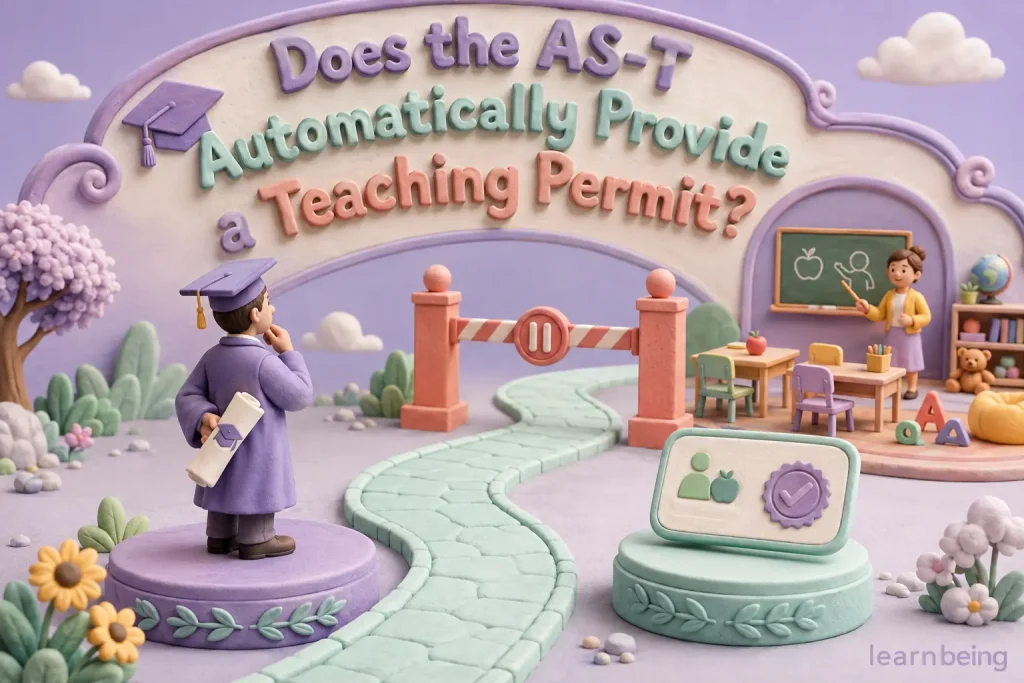
The Early Childhood Education AS-T and the California Child Development Permit are related, but they are not the same credential.
The AS-T is an academic degree awarded by Santa Ana College. A Child Development Permit is a professional authorization issued through California’s credentialing system.
California has several permit levels, including:
- Assistant
- Associate Teacher
- Teacher
- Master Teacher
- Site Supervisor
- Program Director
Each level can have its own combination of coursework, general education, supervised field experience, employment experience, and application requirements.
The 25-unit early childhood education core may satisfy important coursework associated with certain permit pathways, but earning the degree does not mean the permit is automatically issued. Students must review the current permit matrix, document any required experience, and submit the appropriate application.
This distinction matters because some publicly funded programs, Head Start settings, and other employers may require a specific permit level.
Career Options After Completing the AS-T
The degree can prepare students for entry-level education and support positions while creating a pathway toward advanced roles after transfer.
Potential positions include:
- Preschool teacher
- Infant or toddler teacher
- Early childhood teaching assistant
- Paraprofessional educator
- After-school program teacher
- Home-based early childhood educator
- Childcare program staff member
- Family childcare provider
- Recreation program assistant
- Classroom aide
Actual eligibility depends on the employer, setting, permit requirements, work experience, and additional credentials.
With a bachelor’s degree and further professional preparation, graduates may pursue roles such as:
- Lead preschool teacher
- Early childhood program coordinator
- Child development specialist
- Family services professional
- Curriculum specialist
- Site supervisor
- Program director
- Early intervention professional
- Community education coordinator
Students interested in teaching transitional kindergarten, elementary school, special education, or another public-school level should research the separate California credential requirements for those positions.
How Long Does the Program Take?
A full-time student may be able to complete the degree in approximately two academic years. However, completion time depends on:
- The number of units taken each semester
- English and mathematics placement
- Course availability
- General education choices
- Previously completed college credit
- Work and family responsibilities
- Summer or intersession enrollment
- Practicum scheduling
- Changes in transfer goals
Part-time students may need additional semesters. Meeting with a counselor early can help students arrange prerequisites and avoid delaying the practicum or graduation.
Can the Program Be Completed Online?
Some child development and general education courses may be available online or in hybrid formats. However, the practicum includes supervised field experience, so students should not assume that the entire degree can be completed without an in-person component.
Course formats can change by semester. Students should check the current class schedule and confirm fieldwork expectations before planning an entirely online pathway.
Benefits of Choosing the Santa Ana College ECE AS-T
A Defined Transfer Route
The AS-T organizes lower-division coursework around CSU transfer expectations. This can make degree planning more direct for students who already know they want to earn a bachelor’s degree.
Practical Classroom Experience
The required practicum allows students to apply theory in an educational setting. This can strengthen professional confidence and help students decide whether classroom work fits their interests.
Broad Early Childhood Knowledge
The curriculum covers development, curriculum, assessment, family relationships, health, safety, diversity, and professional practice rather than concentrating on one narrow subject.
Preparation for Multiple Roles
The skills can apply to preschools, childcare centers, community programs, after-school services, home-based education, and paraprofessional positions.
A Foundation for Career Advancement
A bachelor’s degree may lead to broader opportunities in program leadership, family services, child development, early intervention, and education administration.
Challenges Students Should Consider
Early childhood education can be meaningful, but it also requires patience, consistency, emotional maturity, and strong communication.
Students should be prepared for:
- Working closely with children and families
- Managing multiple needs at the same time
- Documenting observations carefully
- Responding professionally to challenging behavior
- Following safety and confidentiality procedures
- Completing supervised field experience
- Meeting permit or employer requirements
- Continuing their education for advanced positions
A genuine interest in children is important, but professional early childhood education also requires planning, accountability, teamwork, and continuous learning.
How to Get Started
A practical enrollment and transfer plan may include the following steps:
- Apply for admission to Santa Ana College.
- Complete the required orientation and placement processes.
- Select Early Childhood Education AS-T as the intended academic program.
- Meet with an academic or transfer counselor.
- Create a comprehensive student education plan.
- Confirm the correct general education pattern.
- Review articulation agreements for preferred CSU campuses.
- Register for major and general education courses in a workable sequence.
- Apply for financial aid or scholarships if eligible.
- Review practicum and permit requirements before the final year.
- Petition for graduation by the appropriate deadline.
- Complete the CSU application and transfer-verification process.
Students with previous college coursework should request an official evaluation because some completed classes may satisfy major, general education, or elective requirements.
Tips for Completing the Degree Successfully
- Meet with a counselor before the first semester.
- Choose potential CSU campuses early.
- Keep the GPA above the minimum whenever possible.
- Do not postpone required courses without checking prerequisites.
- Plan the practicum around work and family responsibilities.
- Save course assignments that demonstrate curriculum and observation skills.
- Gain experience working with children when possible.
- Learn the difference between a degree, certificate, permit, and teaching credential.
- Confirm that every selected class is transferable and applies to the education plan.
- Review transfer requirements again before submitting university applications.
Frequently Asked Questions
What does AS-T mean in early childhood education?
AS-T means Associate in Science for Transfer. It is a community college degree designed to prepare eligible students for transfer into a related CSU bachelor’s program.
How many units are required for the Santa Ana College Early Childhood Education AS-T?
The major includes 25 units of required core coursework. Students must complete at least 60 CSU-transferable semester units for the entire degree.
What GPA is required?
Students need a minimum 2.0 GPA in CSU-transferable coursework. A higher GPA may be required to compete for admission to certain campuses or majors.
Does the degree guarantee admission to Cal State Fullerton?
No. Eligible AS-T graduates receive an admission guarantee within the CSU system, but the guarantee does not apply to a particular campus or major.
Does the program include classroom experience?
Yes. The required core includes a four-unit practicum involving student teaching field experience.
Can I become a preschool teacher with this degree?
The degree can prepare students for preschool teaching and related early childhood roles. Employment eligibility may also depend on the type of program, work experience, background requirements, and the appropriate California Child Development Permit.
Is the AS-T the same as a Child Development Associate credential?
No. An AS-T is an academic associate degree. The Child Development Associate, commonly called a CDA, is a separate professional credential. California Child Development Permits are also separate from both.
Can I transfer to a University of California campus with this degree?
Individual courses may transfer to a UC campus, but the formal Associate Degree for Transfer guarantee applies to the CSU system. Students considering a UC should follow the correct admission, general education, and major-preparation requirements with help from a counselor.
What bachelor’s degree can I pursue after the AS-T?
Possible majors include Early Childhood Education, Child Development, Human Development, and Child and Adolescent Studies. Available and similar majors vary by CSU campus.
Is the program only for people who want to become preschool teachers?
No. Graduates may pursue classroom, after-school, family-support, home-based education, paraprofessional, and community-program roles. A bachelor’s degree can open additional opportunities in leadership and specialized services.
Conclusion
The Santa Ana College Early Childhood Education AS-T offers more than a route to an associate degree. It gives students a structured way to understand children, practice responsible teaching, and prepare for university transfer without losing sight of the human side of education.
Working with young children is built from small moments: noticing when a child is struggling, designing an activity that sparks curiosity, listening carefully to a family, and creating a classroom where every child feels welcome. The AS-T provides the theory behind those moments and the practical experience needed to handle them thoughtfully.
For students who want both early childhood classroom preparation and a clear CSU transfer pathway, this degree can be a meaningful first step toward a lasting career in education.

admin
Helping students learn better, prepare smarter, and build real career skills at LearnBeing.
View all posts