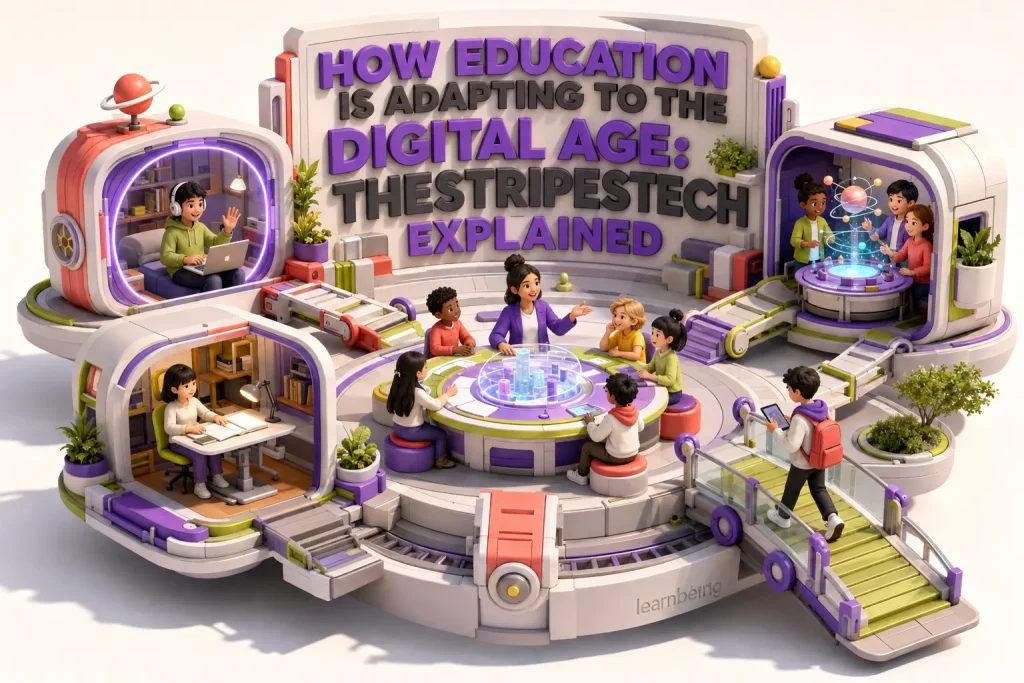
Education is no longer limited to printed textbooks, fixed timetables, and lessons delivered inside a physical classroom. Digital technology has expanded where, when, and how people learn. Students can attend virtual classes, receive personalized exercises, collaborate with classmates across borders, and access educational resources from almost any location.
However, digital transformation in education involves more than placing computers in classrooms. It requires schools to rethink teaching methods, assessment, accessibility, teacher training, student safety, and the skills learners will need in a technology-driven world.
Understanding how education is adapting to the digital age TheStripesTech means examining both sides of this transformation: the opportunities created by educational technology and the challenges institutions must solve to use it responsibly.
What Digital Transformation in Education Really Means
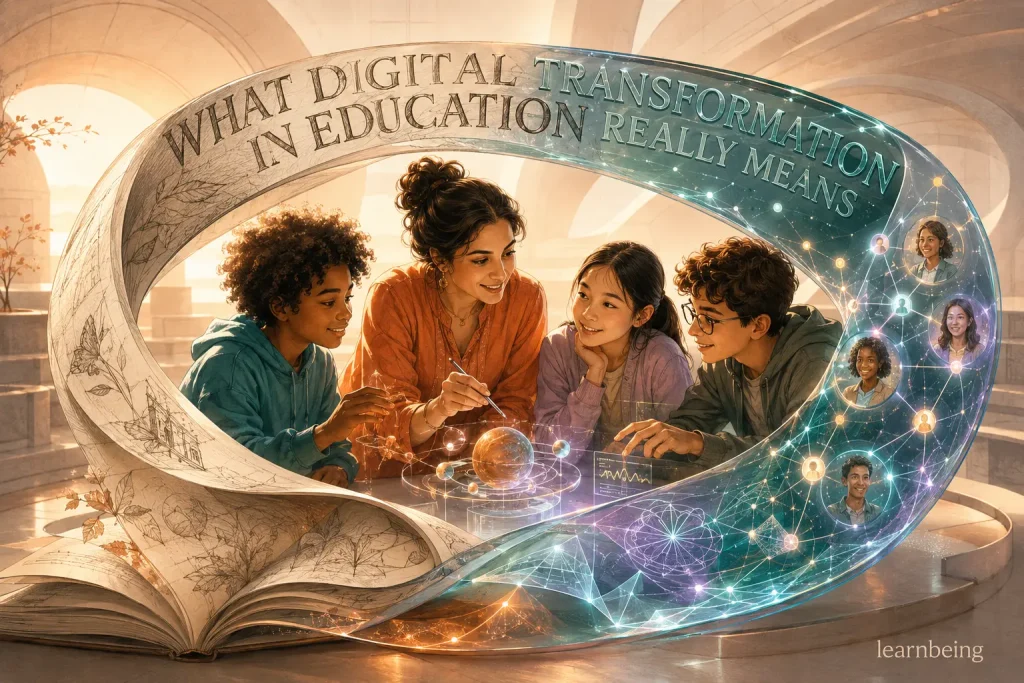
Digital transformation in education is the thoughtful integration of technology into teaching, learning, assessment, communication, and school administration.
It can include:
- Online learning platforms
- Learning management systems
- Artificial intelligence tools
- Digital textbooks and libraries
- Virtual classrooms
- Educational applications
- Interactive quizzes and simulations
- Cloud-based collaboration tools
- Virtual and augmented reality
- Data-driven student assessments
The goal is not simply to convert printed worksheets into digital files. Effective transformation changes the learning experience itself. It gives students more flexibility, helps teachers identify individual needs, and makes educational content more interactive.
Technology should support good teaching rather than become the purpose of teaching.
Traditional Education vs Digital-Age Education
The digital classroom differs from the traditional classroom in several important ways.
| Learning Area | Traditional Education | Digital-Age Education |
|---|---|---|
| Learning location | Mainly inside a classroom | Classroom, home, workplace, or mobile |
| Learning materials | Printed books and worksheets | Videos, applications, e-books, simulations, and online libraries |
| Student pace | Mostly determined by the class schedule | Can be adjusted to individual progress |
| Teacher’s role | Main source of information | Instructor, facilitator, mentor, and learning designer |
| Assessment | Periodic tests and written examinations | Continuous quizzes, projects, analytics, and instant feedback |
| Collaboration | Primarily limited to classmates | Local and international digital collaboration |
| Accessibility | Dependent on physical location and resources | Wider access through online and assistive technologies |
| Learning structure | Mostly standardized | More personalized and competency-based |
| Essential skills | Subject knowledge and memorization | Subject knowledge, digital literacy, problem-solving, and critical thinking |
Traditional teaching still offers valuable structure, face-to-face communication, and personal guidance. Digital-age education builds on those strengths by adding greater flexibility, personalization, and access.
Key Ways Education Is Adapting to the Digital Age
Blended and Hybrid Learning
Blended learning combines classroom instruction with digital activities. A student might attend an in-person lesson, watch a supporting video at home, complete an online quiz, and discuss the topic through a learning platform.
Hybrid learning offers even greater flexibility by allowing some learners to participate remotely while others attend physically.
These models can provide:
- Greater control over learning schedules
- Easier access to recorded lessons
- More opportunities for independent study
- Continuity during illness, travel, or emergencies
- A balance between digital convenience and human interaction
A well-designed blended course does not merely add online homework. It connects physical and digital activities into one consistent learning journey.
Artificial Intelligence and Personalized Learning
Artificial intelligence in education is helping institutions move away from a completely identical learning path for every student.
AI-powered and adaptive learning systems can examine how a student performs and adjust the difficulty, sequence, or format of upcoming activities. A learner struggling with fractions may receive additional examples, while another who has mastered the topic can move to more challenging work.
AI can also support teachers by:
- Creating practice questions
- Suggesting lesson activities
- Identifying learning patterns
- Providing basic tutoring assistance
- Translating or simplifying educational material
- Supporting faster formative assessment
- Organizing administrative information
AI-generated answers can be incomplete, biased, or inaccurate, so human review remains essential. Students must also learn to question AI output rather than treating it as automatically correct.
Online Learning Platforms
Online learning platforms have made education more accessible beyond the traditional school day. Learners can review lessons, submit assignments, join discussions, and track progress through a single digital environment.
These platforms are commonly used for:
- Full online courses
- Homework management
- Professional certifications
- University programs
- Employee training
- Language learning
- Short skills-based lessons
- Teacher-student communication
This flexibility is especially helpful for working adults, students in remote areas, and people who cannot regularly attend a physical institution.
Learning Management Systems
A learning management system, often called an LMS, helps institutions organize the digital learning process.
Teachers can use an LMS to:
- Upload lessons and resources
- Set deadlines
- Collect assignments
- Deliver quizzes
- Record grades
- Share announcements
- Monitor participation
- Communicate with students
For learners, it creates one central location for course materials, feedback, schedules, and academic progress. The most successful systems are easy to navigate, mobile-friendly, accessible, and supported by clear training.
Interactive Content and Gamification
Digital learning is increasingly moving beyond static pages. Interactive videos, quizzes, educational games, and simulations encourage students to participate instead of simply consuming information.
Gamification may introduce elements such as:
- Progress levels
- Achievement badges
- Learning challenges
- Points and rewards
- Immediate feedback
- Class or individual goals
These features can improve motivation when they support a meaningful educational objective. However, rewards should not become more important than understanding the subject.
Virtual Reality and Augmented Reality
Virtual reality and augmented reality can turn abstract or inaccessible topics into practical learning experiences.
Students may use immersive technology to:
- Explore a historical location
- Examine a three-dimensional human organ
- Conduct a simulated science experiment
- Practise operating technical equipment
- Walk through a virtual building design
- Train for emergencies without physical danger
Simulation-based learning is particularly useful in medicine, engineering, aviation, manufacturing, and vocational education. It allows learners to practise decisions and procedures in a controlled environment.
Digital Assessments and Immediate Feedback
Traditional examinations usually show what a student knew at one particular moment. Digital assessments can provide smaller and more frequent checks throughout the learning process.
Online quizzes and classroom response tools can reveal:
- Which concepts students understand
- Where common mistakes are occurring
- Who may need additional support
- Whether a lesson should be reviewed
- How student performance changes over time
Immediate feedback allows students to correct misunderstandings before they become established. Teachers can then adjust instruction using evidence rather than assumptions.
Microlearning and Mobile Education
Microlearning delivers information in short, focused lessons. A learner may watch a five-minute explanation, complete a quick exercise, and apply one specific skill.
This approach works well for:
- Professional development
- Language practice
- Software training
- Revision activities
- Workplace safety
- Technical procedures
Mobile learning makes these lessons available through smartphones and tablets. It allows education to fit around work and personal responsibilities, although content must be carefully designed for smaller screens.
Accessible and Inclusive Learning
Digital technology can improve access for learners with different physical, sensory, linguistic, or learning needs.
Accessibility features may include:
- Screen-reader compatibility
- Captions and transcripts
- Keyboard navigation
- Adjustable font sizes
- Text-to-speech tools
- Speech-to-text software
- Alternative text for images
- Translation assistance
- Flexible lesson formats
Accessibility should be included during course design rather than added after problems appear. A platform that cannot be used by every intended learner is not truly effective.
How the Teacher’s Role Is Changing
Digital education does not eliminate the need for teachers. It changes where their greatest value lies.
When basic information is widely available online, teachers become responsible for helping students interpret, question, connect, and apply that information. Their role increasingly includes being a:
- Learning facilitator
- Mentor and motivator
- Digital content evaluator
- Discussion leader
- Project supervisor
- Technology guide
- Source of personalized support
- Protector of academic standards
Teachers also help students distinguish credible information from misinformation. This responsibility has become increasingly important because online content can be published quickly without expert review.
Professional development must accompany technology adoption. Giving educators new software without sufficient time, guidance, and technical support can increase workload instead of improving instruction.
Skills Students Need in the Digital Age
Modern education must prepare students to use technology productively, ethically, and independently.
Digital Literacy
Digital literacy includes more than knowing how to operate a device. Students must understand how to search, communicate, create, protect information, and evaluate online material.
AI Literacy
Learners should understand what artificial intelligence can do, where it can fail, and how it may influence decisions. They should be able to use AI as a learning aid without surrendering their own judgment.
Critical Thinking
Access to more information does not automatically create better understanding. Students need to compare sources, recognize weak evidence, identify manipulation, and form reasoned conclusions.
Media and Information Literacy
Students regularly encounter sponsored content, edited images, misleading headlines, and false claims. Media literacy helps them evaluate who created a message, why it was created, and whether it deserves trust.
Online Safety and Cybersecurity
Digital education requires awareness of strong passwords, phishing, privacy settings, suspicious downloads, responsible sharing, and online harassment.
Collaboration and Communication
Modern workplaces often rely on shared documents, video meetings, project platforms, and international teams. Students therefore need to communicate clearly across both physical and digital environments.
Self-Directed Learning
Flexible education gives learners more control, but it also requires discipline. Time management, goal setting, organization, and independent problem-solving are essential for online learning success.
Benefits of Digital Education
When technology is selected carefully and supported by effective teaching, it can offer several advantages.
Flexible Access
Students can learn from different locations and review lessons at convenient times. Recorded resources are particularly valuable when learners need additional explanation.
Personalized Support
Adaptive systems and learning analytics can help educators identify individual strengths, weaknesses, and patterns of progress.
Greater Student Engagement
Multimedia, interactive activities, simulations, and collaborative projects can make difficult topics easier to understand.
Faster Feedback
Digital assessments allow learners to see mistakes quickly and give teachers timely information about class performance.
Wider Educational Resources
Students are no longer limited to the materials available inside one building. Digital libraries, expert lectures, virtual laboratories, and open educational resources can expand learning opportunities.
Preparation for Employment
Using digital tools during education helps students develop skills they will encounter in modern workplaces.
Administrative Efficiency
Automation can reduce repetitive tasks such as organizing records, distributing materials, scheduling assessments, and grading simple quizzes. This may give teachers more time for planning and individual support.
Challenges of Education in the Digital Age
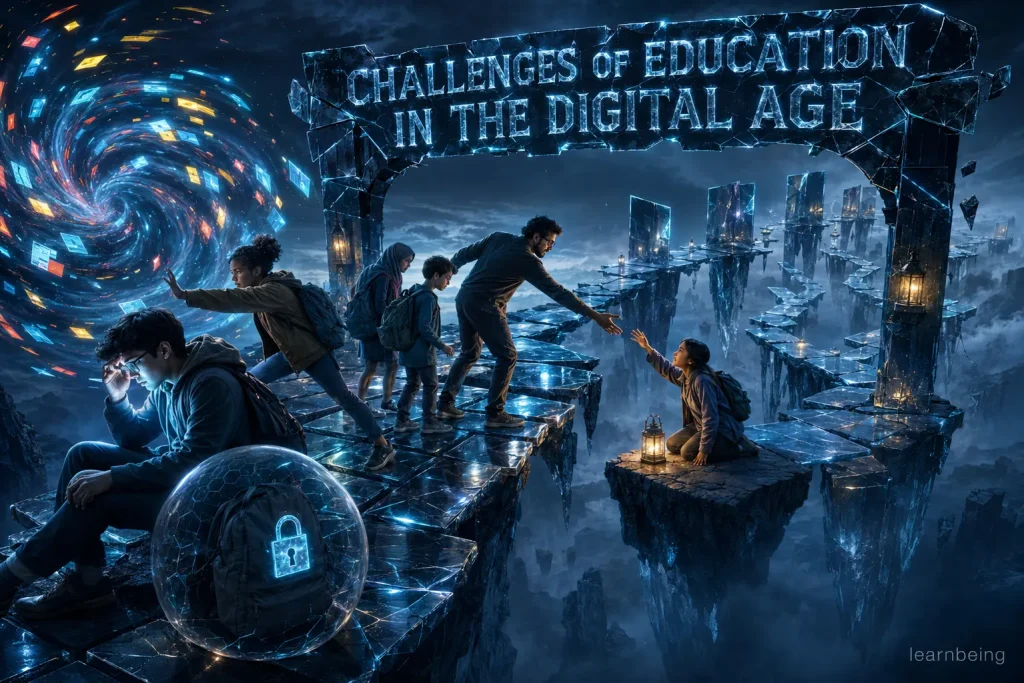
Technology can improve learning, but it can also create new difficulties.
The Digital Divide
Not every student has a reliable device, stable internet connection, quiet study environment, or sufficient digital skills. Moving essential activities online without addressing these differences can deepen educational inequality.
Institutions may respond by providing:
- Device-lending programs
- Downloadable and offline resources
- Community internet access
- Low-bandwidth learning options
- Technical support for families
- Accessible public learning spaces
Student Data Privacy
Educational platforms may collect names, grades, behavior records, activity data, and other personal information. Schools must understand what is collected, why it is needed, where it is stored, and who can access it.
Distraction and Screen Fatigue
The same device used for education may also provide games, social media, entertainment, and messaging. Long periods of screen use can reduce concentration and create fatigue.
Digital lessons should therefore include discussion, handwriting, physical activity, practical work, and regular breaks.
Academic Integrity
Generative AI and online answer services have made it easier to submit work that does not reflect a student’s own understanding.
Schools are adapting assessments by using:
- Oral explanations
- Practical demonstrations
- Draft reviews
- Reflective writing
- Project-based assignments
- In-class components
- Questions connected to personal learning experiences
The focus is shifting from simply producing an answer to demonstrating how the answer was developed.
Uneven Content Quality
Not every educational application is accurate, age-appropriate, accessible, or supported by evidence. Attractive design should not be mistaken for educational value.
Insufficient Teacher Training
Technology cannot deliver its full value when educators are not confident using it. Training should cover teaching methods, accessibility, data privacy, AI limitations, troubleshooting, and student safety.
Loss of Human Connection
Education involves relationships, encouragement, discussion, empathy, and social growth. A fully automated experience cannot reproduce every benefit of learning with teachers and classmates.
How Schools Can Adapt Responsibly
Successful digital transformation requires a clear strategy rather than purchasing the newest technology available.
Begin With the Learning Objective
Schools should identify the educational problem before selecting a tool. Technology should answer a genuine need, such as improving feedback, increasing accessibility, or supporting practical simulations.
Assess Infrastructure and Access
Institutions must examine internet reliability, device availability, technical support, accessibility, and students’ home-learning conditions.
Involve Teachers and Students
The people who will use a platform should participate in evaluating it. Their feedback can reveal usability problems that decision-makers might otherwise overlook.
Provide Continuing Teacher Development
One introductory workshop is rarely sufficient. Educators need practical training, planning time, examples, peer support, and continuing assistance.
Establish Clear AI and Privacy Policies
Policies should explain acceptable AI use, human review requirements, data protection, academic integrity, and consequences for misuse.
Introduce Technology Gradually
A limited pilot program allows institutions to test a platform before applying it across an entire school or university.
Measure Educational Results
Schools should evaluate whether technology improves understanding, participation, accessibility, and teacher efficiency. Login numbers alone do not prove that learning has improved.
Maintain Human Interaction
Digital tools work best when combined with mentoring, discussion, collaboration, creative work, and meaningful teacher feedback.
How Digital Adaptation Differs Across Education Levels
Primary Education
Younger students benefit from interactive stories, visual explanations, guided activities, and educational games. Adult supervision and balanced screen time remain especially important.
Secondary Education
Digital platforms can support deeper research, collaborative projects, coding, media literacy, career exploration, and subject-specific simulations.
Higher Education
Universities increasingly use hybrid courses, recorded lectures, virtual laboratories, online discussion spaces, digital research collections, and flexible credentials.
Vocational Education
Simulations, augmented reality instructions, and virtual equipment can help learners practise technical tasks before working with expensive or potentially dangerous machinery.
Adult and Professional Learning
Short online courses, mobile lessons, and industry certifications allow adults to update their skills without leaving employment.
The Future of Digital Education
The future of education is likely to be more flexible, personalized, and connected, but it should also become more human-centered.
Expected developments include:
- AI-supported tutoring with teacher oversight
- More personalized learning pathways
- Growth in skills-based and competency-based assessment
- Wider use of simulations and immersive learning
- Portable digital credentials
- More accessible multilingual content
- Stronger digital citizenship education
- Greater emphasis on AI ethics and information literacy
- Continuous professional learning throughout a person’s career
The strongest educational systems will not be those using the greatest number of digital tools. They will be the ones choosing technology carefully, protecting learners, training teachers, and measuring whether genuine learning has occurred.
Frequently Asked Questions
What does “how education is adapting to the digital age TheStripesTech” mean?
It refers to the ways schools, universities, teachers, and learners are responding to technological change. These adaptations include online learning, artificial intelligence, digital assessments, virtual classrooms, personalized instruction, and stronger digital literacy education.
How is technology changing education?
Technology is making education more flexible, interactive, accessible, and data-informed. It allows students to learn from different locations, receive faster feedback, and use resources beyond traditional textbooks.
Will technology replace teachers?
Technology may automate certain administrative and repetitive tasks, but it cannot replace the full role of a teacher. Educators provide judgment, motivation, emotional support, context, and meaningful human interaction.
What is the biggest challenge facing digital education?
The digital divide remains one of the most serious challenges. Students without reliable devices, connectivity, digital skills, or home support may be placed at a disadvantage.
How is AI being used in education?
AI can support personalized practice, tutoring, content creation, translation, assessment, and performance analysis. Its output still requires human oversight because it may contain errors or bias.
What is blended learning?
Blended learning combines face-to-face teaching with online lessons, digital resources, assessments, or activities. It attempts to preserve classroom interaction while adding digital flexibility.
Are traditional classrooms becoming obsolete?
No. Physical classrooms remain important for discussion, social development, practical activities, and direct support. The more likely future is a combination of traditional and digital learning.
How can schools protect student information?
Schools can collect only necessary data, carefully review technology providers, limit access, strengthen cybersecurity, train staff, and establish transparent privacy policies.
What digital skills should students learn?
Important skills include online research, media literacy, AI literacy, cybersecurity awareness, digital communication, problem-solving, collaboration, and responsible content creation.
Conclusion
Education is adapting to the digital age by becoming more flexible, personalized, interactive, and connected. Online platforms, artificial intelligence, virtual classrooms, digital assessments, and immersive technology are expanding what students and teachers can accomplish.
Yet meaningful progress depends on more than new devices or software. Schools must protect privacy, close access gaps, prepare teachers, preserve human relationships, and ensure technology serves a clear educational purpose.
The central lesson behind how education is adapting to the digital age TheStripesTech is straightforward: technology can strengthen education, but only thoughtful teaching can turn that technology into genuine learning.

admin
Helping students learn better, prepare smarter, and build real career skills at LearnBeing.
View all posts